
I am an autistic painter and, as such, fall outside the traditional realm of what constitutes an academic art historian. I am studying for a PhD in art history and have had several articles published in peer-reviewed journals, but as my ideas are quite often unexpected and unconventional, I find they are often sidelined as they do not fit neatly – or comfortably – into existing frameworks of understanding. In this piece I will reflect on ways in which my perceptions and insights as a painter and autistic researcher have helped me to see the work of Michelangelo from a new perspective.
This reflection will focus on my personal experience of writing my recent book, Michelangelo’s Puzzle: Forgery, Star Maps, and the Sistine Chapel (2025). In my book I suggest a new understanding of the Sistine Chapel frescos, as an intellectual Renaissance puzzle based on the symbolism and imagery of the stars. I also question the authenticity of a sculpture that Michelangelo referenced many times in these frescos, the Vatican’s Laocoön Group. I build on Lynn Catterson’s article from 2005, in which she argues that Michelangelo forged this famous sculpture, and my own article from 2019 that highlights the distinct difference in pose between the Laocoön Group and all the other ancient depictions of Laocoön’s death. In the book I also raise the possibility that Michelangelo drew on the traditional connection in star lore between Laocoön and the constellation of Ophiuchus to present the famous sculpture in a new celestial context, and that he situated this imagery in a devout setting where it could signify his personal desire for atonement and salvation.
My experience as a painter
Seeing the art of others through the lens of my own creative practice does not make my ideas any more valid than those of conventional art historians, but my perspective is different and that inevitably shapes the sort of questions I ask and the interpretations I pursue. The former American Director of Intelligence, Roger Hilsman (1956), noted that data gained through skilled operators in the field was equally as important as that gained by scholars through observation and study, and that it can be difficult for people with first-hand experience to fully communicate all aspects of their specialised knowledge. The idea that both first-hand experience and second-hand knowledge should be taken into consideration is equally relevant to the creative arts and art-historical research.
As for my own creativity, I have always enjoyed portraiture and still, when talking to someone, cannot help tracing the contours of their face with my eyes. My interests expanded overtime to include other subjects, such as architecture and wildlife, and more recently abstract expressionism. In my experience, important aspects of creativity that develop with practice include a good visual memory, sustained deep engagement for hours on end, and the ability to transform objects in the mind’s eye. There is also a deep excitement around ambiguous imagery that can lead to a rich layering of meaning. As a researcher, it is very useful to understand all of these factors when considering artwork created by others as such insights can open up fascinating lines of enquiry.
My lived experience of autism
My painting reflects the experiences I have of the world and this, in turn, is shaped by the perceptions I have as an autistic person. It is not possible for me to neatly unpick the relative influence and impacts of creativity and autism on my painting and art-historical research. For me they are intrinsically interwoven, with each seemingly feeding off the other.
It is important to state that autism spectrum disorder spans a range of characteristics. From my personal perspective, there are some challenging aspects of autism that make parts of my life quite difficult. Getting out to see exhibitions and archives – let alone to the Vatican in Rome – can be utterly overwhelming due to crowds of people, noise, and unfamiliar environments. Public speaking and answering questions without having enough time to process my ideas have also proved tough obstacles to navigate. Social anxiety, imprecise instructions, and the unexpected disruption to routine can also significantly negatively impact my ability to function at my best.
On the flipside, autism can bring with it a predisposition to remember visual imagery, to identify patterns, and to make connections between apparently disparate sources. Autistic people tend also to be drawn to special interests into which they can immerse themselves. I can also experience periods of hyperfocus, during which all sense of time and the outside world is lost. The autistic scientist, Camilla Pang (2020) has described how such flow states can bring intense levels of concentration and deep learning – as well as a great sense of joy and calm.
What helped me to write my book
When considering how my artistic practice and my autism might have helped me succeed in getting my book published, I would have to say that first and foremost my intense, almost obsessive, interest in Michelangelo helped me to stay on track, despite numerous difficulties and setbacks. My resistance to social conformity, along with a certain degree of hierarchy blindness, means I tend to weigh my own observations alongside established theories, rather than automatically deferring to dominant narratives. My drive to convey the details of what I observed and my deep engagement with the subject helped me to keep going when publisher after publisher seemed hesitant to engage with such a radical new interpretation of Michelangelo’s work.
On a practical level, I always like to explain my ideas in a straightforward way so that they are as accessible as possible – partly because, being autistic, I can find abstract language very difficult to follow. I also tried to set aside protected periods of time for writing, as I find interruptions and transitioning between tasks quite difficult.
Also relevant to research is the deep-rooted sense of moral justice and empathy that autistic people can experience when it comes to fairness. The drive to challenge inconsistencies and inequality is something that fuels my own research, partially because there seems to be such a strong reliance on empirical, scientific fact over observations drawn from the lived experience of practicing artists. Letters, diaries and official documentation can be an incredibly valuable source of information, but they have limitations. Much of the creative process is often left undocumented – to describe every aspect of technique and meaning might well inhibit an observer’s own interpretation. Writing a book about Renaissance puzzles, I was faced with the challenge that solutions were generally passed on by word of mouth, rather than being written down, so that the pleasure of discovery would not be unduly spoilt for others. In this case, absence of evidence can almost be reframed, not as a weakness but as a feature of the artistic culture in which enigmatic work was created.
The start of my research into Michelangelo – the face
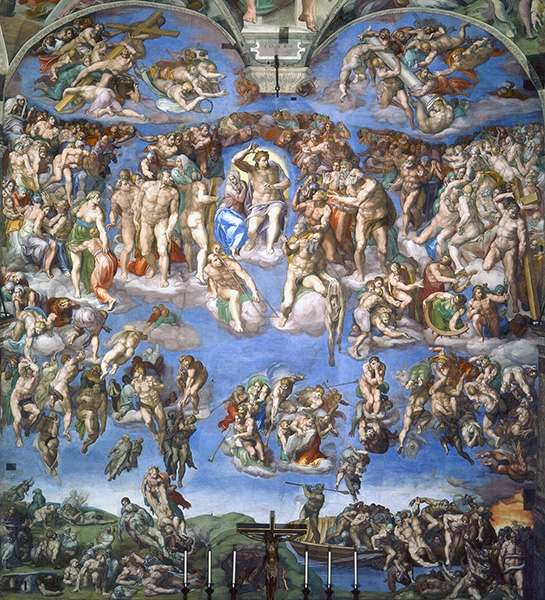
My research into Michelangelo started with a series of serendipitous events. I was researching the self-portraits of Paula Modersohn-Becker and, whilst leafing through her journals and letters, I stumbled across some entries in which she described her fascination for the work of Michelangelo. I pulled down a hefty old art book and found myself staring at a photograph of the Last Judgement from the altar wall in the Sistine Chapel (figure 1). What I saw took me by surprise - like an intense revelation.
When my children were young, we made pictures together, very often portraits in which they would draw out a face - with a particular emotion in mind - and I would paint their realistic face looking through their artwork (figures 2 and 3). The final image represented a confluence of two separate artworks, but together they made something entirely new, something that spoke to our individual personalities, our imagination and emotions, and to the relationship between a mother and her child.
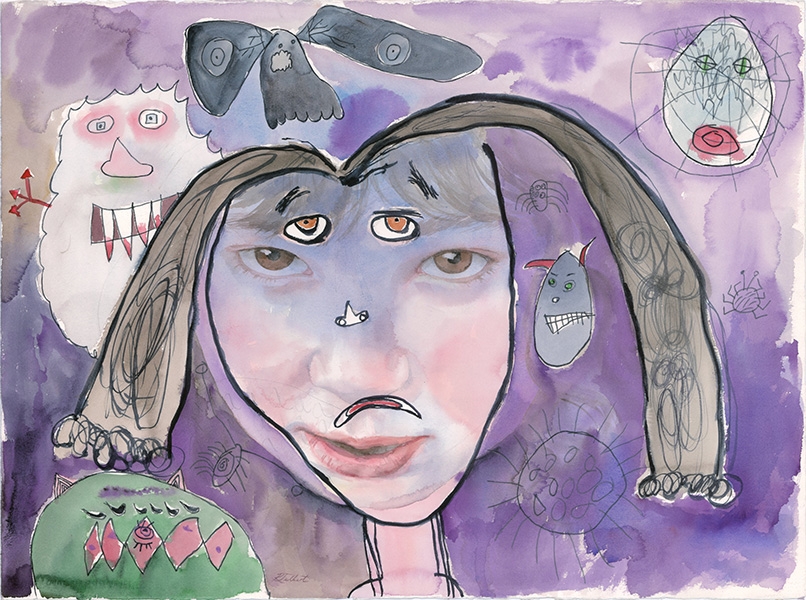
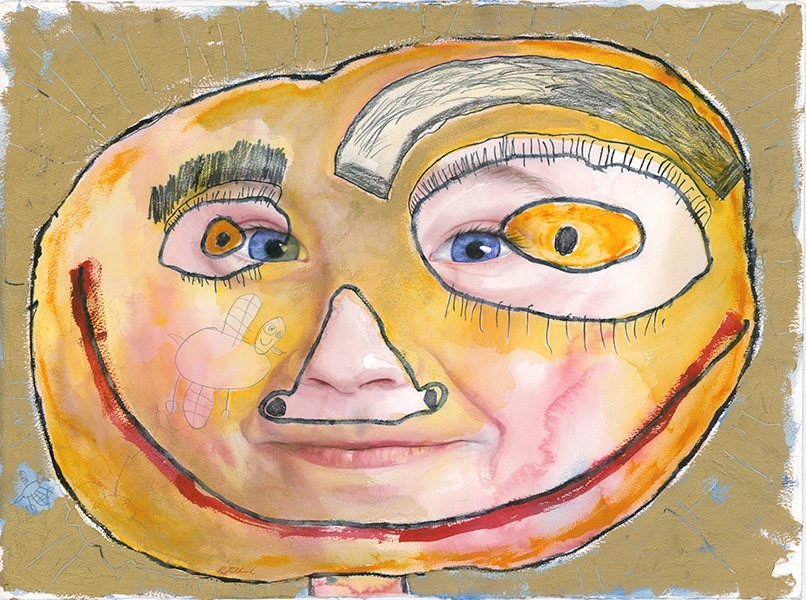
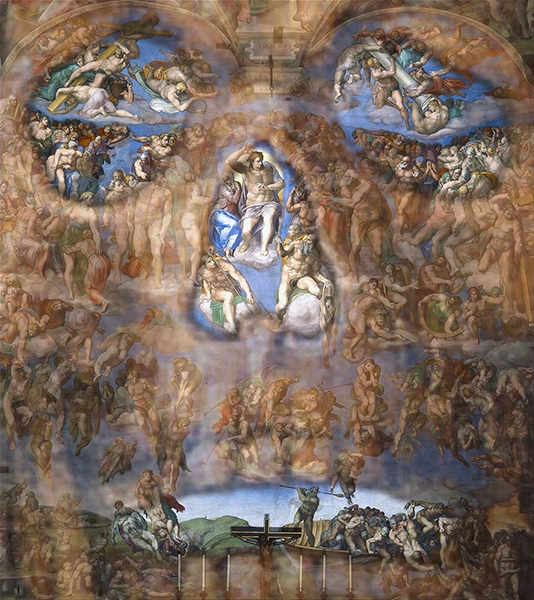
If you paint portraits, you learn the proportions and subtle details of the face on an instinctive, unconscious level. When I looked at Michelangelo’s Last Judgement, I saw a face looking back at me. I tried to dismiss it, as an instance of pareidolia – like seeing a face on the moon - but this seemed different, as details in the fresco appeared to emerge from the composition to flesh out the imagined portrait. The lower curve of the blue almonds at the top became closed lids, blue streams of tears tricked down the planes of both cheeks and past the nose that had nostrils plumped with spherical clouds. The glowing image of Christ became the bridge of the nose, and Michelangelo’s strange, central self-portrait in the skin of St. Bartholemew appeared to drip from the tip. Below the nose, the double curve of the green hill and small boat together made the silhouette of the back of a tongue, behind which rose white mist like breath emerging from the throat.
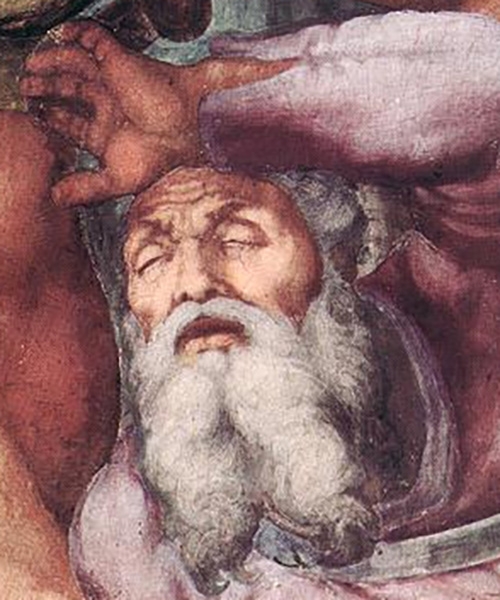
The overall impression – of a person with closed eyes and a parted mouth – resonated for me with the self-portrait Michelangelo painted just after finishing the Last Judgement, in which he painted himself as Saul, undergoing a dramatic conversion into St. Paul (figure 4). Is it possible that he cast himself as Saul as a way of offering a subtle clue to the hidden face in the Last Judgement? Could Saul’s blinding vision have been intended as a metaphor for the direct encounter with the divine that awaited the worthy on the Last Day?
I would later find out that Philip Dayvault (2012) and Jos Verhulst (2014) had written papers on the presence of a face in Michelangelo’s Last Judgement, although they argued that the composition mirrored Christ’s face in the Turin Shroud. Written from a Christian perspective, these authors proposed that Michelangelo was not aware of this allusion and that his hand was guided by God. In opposition to this, I suggest that Michelangelo created a face as an important, intentional element in his fresco, the radical nature of which has been hiding in plain sight for around 500 years.
Seeing stars
I went searching for connections between Renaissance imagery and the face, and almost straight away I was presented with images of zodiacal men, labelled with star constellations – small flesh-and-blood microcosms of the wider, divine universe. Some were complete figures but others were represented by their head alone, with the various features of the face clearly linked to different star constellations (figure 5).
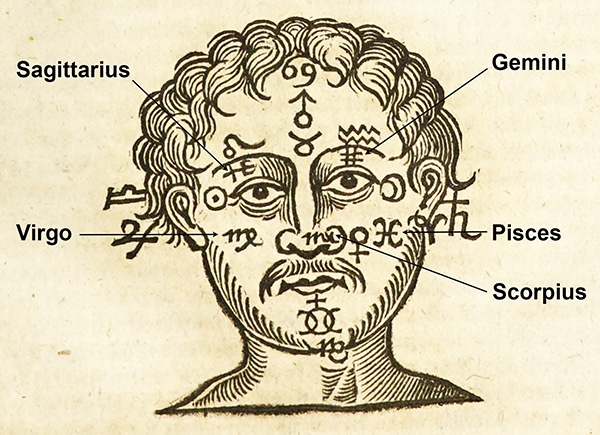
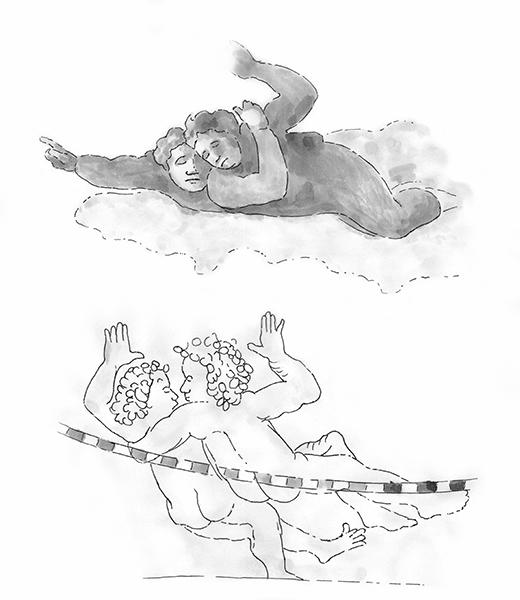
Looking for an early map of the skies over the northern hemisphere, I came upon what is known as the Vienna Manuscript, created in the fifteenth century. Starting with the eyes of the zodiac man, I could see that the constellation linked to his left eye was Gemini. Following a playful hunch, I searched the upper right section of Michelangelo’s Last Judgement for a similar set of figures and was astounded to find a comparable couple at the edge of the large, blue almond shape (figure 6). The visual affinity between the celestial illustration and the two entwined figures floating along the top of the altar wall was striking. I would subsequently find other figures in the Last Judgement that appeared to evoke traditional celestial illustrations for several further constellations.
The Sistine Chapel ceiling
My attention was finally turned to the Sistine Chapel ceiling, where Michelangelo seems to have made further references to the stars. I suggest that he did so by including figures based on celestial illustrations, by mapping some compositions to the shape of specific star constellations, and through the visual quotation of well-known sculptures and reliefs. In Deluge, the image of Atlas holding up the sky is evoked in the foreground through a reference to the Farnese Globe; in the neighbouring Sacrifice of Noah, the image of Mithras sacrificing the bull (that once symbolised a star map) is brought to mind through a reference to an ancient relief.
I suggest that Michelangelo evoked a specific trail of stars that stretches across the Sistine Chapel ceiling by alluding to characters traditionally linked to star lore. To give two examples: the mythic character of Icarius, who received the gift of wine from Bacchus, was connected in star lore with the constellation Boötes, and we can see details of the Icarius Relief in Michelangelo’s Drunkenness of Noah. Laocoön struggling with the deadly sea serpents was associated in star lore with the joint constellations of Ophiuchus and Serpens, and it has been noted by others that the Vatican’s Laocoön Group (or Laocoön and his Sons) is evoked by a number of Michelangelo’s ceiling frescos near the altar wall. I delighted in seeking out and recognising these patterns and connections across the Sistine ceiling.
The Vatican’s Laocoön Group
It was whilst delving into these astronomical quotations that I happened to stumble across Catterson’s (2005) article arguing that Michelangelo forged the Laocoön Group. As Michelangelo’s hidden path of stars ended with a plethora of references to this sculpture, I felt that this artwork must have held great significance for the artist at that point in time. Could there have been more to Michelangelo’s fascination for this sculpture than its fame and brilliance? If Michelangelo did create the Laocoön Group as a forged antiquity, what might this mean for his inclusion of it in the Sistine frescos? Pope Julius II first suggested that Michelangelo paint the Sistine Chapel ceiling just a matter of months after buying the newly unearthed sculpture; could the pope have possibly have found out he had bought a forgery and made Michelangelo paint the ceiling as a form of penance?
When this sculpture was discovered in Rome in 1506, Michelangelo just happened to be at hand to witness it. It was proclaimed the lost Laocoön mentioned by Pliny in his Historia Naturalis, but Pliny had not described the pose or size of the sculpture. It is rarely mentioned in the literature that at least four other ancient sculptures depicting Laocoön’s death were unearthed in Rome during the sixteenth century. Vasari tells us in The Lives of the Most Excellent Painters, Sculptors, and Architects (1568) that Michelangelo created a forged antiquity that was itself unearthed in a Roman vineyard (Sleeping Cupid, 1496; now lost).
After studying the other remaining ancient images of Laocoön’s death, I realised that the pose of the Trojan priest in the Vatican’s Laocoön Group was unusual. Whilst all the others showed Laocoön with one knee raised – to secure the sacrificial bull he was killing when the serpents struck – the priest in the Laocoön Group is seated, with both feet on the ground. Traditional poses in ancient artworks conveyed important, often religious, meaning at a time when many people could not read. The extreme emotion of the priest's contorted face is more akin to Renaissance depictions of the 'Lamentation of Christ' than to ancient sculpture. Catterson also points out that the Laocoön Group was made from seven separate blocks of marble, instead of the single block described by Pliny.
I suggest there are enough questions around the pose and the uncertainty of identification to call for a thorough reappraisal of this famous artwork. The idea that Michelangelo could have used the painting of the Sistine frescos as an opportunity to say something about his forging of the Laocoön Group is fascinating. If indeed it was a forged antiquity, its transformation into a religious work of art could be interpreted as an act of atonement – what better way to represent the notion of religious reparation and transformation than to convert the Laocoön Group into a portrayal of the punishment of pride and God’s own divine act of creation.
Drawing things together – puzzles, portraits and private prayers
After finally completing my research into Paula Modersohn-Becker’s self-portraits, I returned with excitement to Michelangelo and his mystifying Last Judgement. The resonance with the stars, and the apparent mapping of facial features to associated celestial illustrations, put me in mind of a giant puzzle. This line of thought led me into the rich world of intellectual Renaissance puzzle culture, in which enigmatic riddles were found in music, literature and throughout the arts. In the visual arts, intellectual picture puzzles took many forms, including the hunt for a hidden face in tabula scalata pictures, anthropomorphic landscapes, and anamorphic portraits.
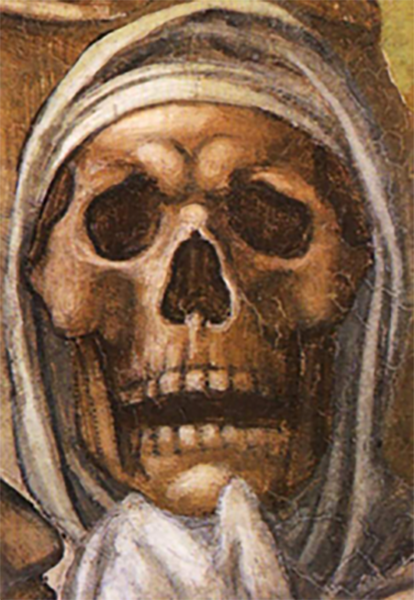
Of these puzzles, Hans Holbein the Younger’s The Ambassadors (1533) caught my particular attention. It was painted around the time Pope Clement VII first conferred with Michelangelo about painting the altar wall; the French ambassador to Rome was the brother of Jean de Dinteville, the man on the left in Holbein’s painting; and the Cosmati floor in The Ambassadors is very similar to areas of the marble design in the Sistine Chapel. If you were to stand on the left-hand side in front of Michelangelo’s Last Judgement you could look up and see a skeletal self-portrait, noted by the art historian Bernadine Barnes (2004), in which the artist looks out directly at the viewer with his painting hand raised to his chin (figure 7). I suggest that this skeletal self-portrait is an important element in understanding the fresco as an intellectual Renaissance puzzle.
Michelangelo is also known to have created other visual puzzles in the Sistine Chapel. In the centre of the Last Judgement, he painted St. Bartholemew with very different features to those in his flayed skin that hangs from one hand. The seated saint has a bald head and beard whereas the face in the skin is a self-portrait of Michelangelo, with dark hair and no beard. Approximately 25 years earlier, he had created anatomical puzzles on the Sistine ceiling, first noted by medical doctors, in which individual compositions map to anatomical details. In all of these, the viewer was invited to imagine one image superimposed over another.
It occurred to me one day that the small skeletal self-portrait at the bottom of the Last Judgement might map onto the features of the face that I could see across the altar wall. I enlarged Michelangelo’s portrait on my computer and positioned the skeletal face so that the eye sockets encircled the apparent closed lids, and the round clouds of the nostrils fell neatly into the bottom of the nasal cavity (figure 8). When set to this scale, other details seemed to fall into place: the two upper front teeth aligned with the squared-off clouds beneath the trumpeters, and one of the lower front teeth mapped to the cave containing two hunched demons. The symmetrical placement of the diagonal cross and pillar evoked optic nerves running towards the brain, and banks of clouds suggested the ridge of the cheek bones.
What could the face mean?
By merging his self-portrait with details of the Last Judgement, was Michelangelo perhaps creating an intended view of his own face under regeneration on the Last Day - to express what it might feel like to come face-to-face with God during the beatific vision? If so, this enormous puzzle could have represented for him a private prayer, a vision of his own salvation. The closed eyes, relaxed lids and parted mouth speak to a man giving himself up to an intense experience, with tears of joy running down his cheeks and the breath of new life rising up from within him. On one level this appears to be a joyous image, full of hope and anticipation that a long life lived for the pursuit of artistic perfection would be finally judged as worthy. At the same time, the presence of the damned being herded towards the mouth of Hell introduces an element of ambiguity and doubt. If Michelangelo did create the Laocoön Group as a forged antiquity, could its prominent presence as Christ, in the altar wall fresco, have been linked to his apparent uncertainty as to whether he might arise to Heaven or slip from St. Bartholemew’s hand into Charon’s infernal boat below?
The importance of serendipity and personal experience in research
My initial perception of a face on the altar wall was borne of years of practice-based work and active study of the human face. It was also informed by a particular set of personal experiences and dispositions, including my interest in anatomy and the stars, my role as a mother, and certain aspects of autism. This could be thought of a serendipitous, but it also involved a perceptual preparedness and an openness of mind. The American historian, James McClellan (2005), notes that the accidents, strokes of luck, and serendipitous events that shape the work of historians are largely invisible in their publications. He argues that authors should contemplate submitting alongside their articles or books an explanation of how the research came into being – demonstrating how the tiniest triggers can ultimately lead to new discoveries, as we see in August Kekulé’s sudden realisation about benzene molecules whist dozing in front of a fire, and Alexander Fleming’s accidental growth of Penicillium mould in a petri dish.
I acknowledge that researchers should be mindful of confirmation bias and an overreliance on speculative readings, but I suggest that the ideas and perspectives of artists can offer a meaningful starting point for further study and discussion. They can also offer valuable insight into the creative process, and what it is to experience the world as an artist. Looking forward, I hope the gap between fact-based scholarship and practice-based insight can be considered a generative space, as an invitation to explore alternative ways of seeing, and as the basis for constructive, interdisciplinary conversations.
References
Barnes, Bernadine. 2004. ‘Skin, Bones, and Dust: Self-Portraits in Michelangelo’s “Last Judgment”’, The Sixteenth Century Journal. 35, no. 4, pp. 969-986, doi:10.2307/20477136
Catterson, Lynn. 2005. ‘Michelangelo’s “Laocoön?”’, Artibus et Historiae. 26, no. 52, pp. 29–56, doi: 10.2307/20067096
Dayvault, Philip E. 2012. ‘Encoded: The Face of the Man of the Shroud of Turin Is Encoded within the Sistine Chapel Frescoes’, (unpublished article) <http://www.datument.com/uploads/1/2/7/9/12790801/encoded-article-de_website-download-r-1-21-13.pdf> [accessed 24 April 2026].
Hilsman, Roger. 1956. Strategic Intelligence and National Decisions (The Free Press)
Jelbert, Rebecca. 2025. Michelangelo’s Puzzle: Forgery, Star Maps, and the Sistine Chapel (Bloomsbury Academic)
Jelbert, Rebecca. 2019. ‘Aping the Masters?: Michelangelo and the “Laocoön Group”’, Journal of Art Crime, no. 22, Fall/ Winter 2019, pp. 3-16
Jelbert, Rebecca. 2017. ‘Paula Modersohn-Becker’s Self-Portraits and the Influence of Dante Gabriel Rossetti’, The Burlington Magazine, 159, August 2017
McClellan, James E. 2005. ‘Accident, Luck, and Serendipity in Historical Research’, Proceedings of the American Philosophical Society, 149, no. 1
Pang, Camilla. 2020. Explaining Humans: What Science Can Teach Us About Life, Love and Relationships (Viking)
Vasari, Giorgio. 1568. Le Vite de più eccellenti architetti, pittori, et scultori italiani, da Cimabue insino a' tempi nostri (The Lives of the Most Excellent Painters, Sculptors, and Architects), (Giunti)
Verhulst, Jos. 2014. ‘The Embedment of the Face on the Shroud of Turin in Michelangelo’s Last Judgement: A Corroboration of the Dayvault Hypothesis’, (unpublished article) <https://www.academia.edu/8972988/THE_EMBEDMENT_OF_THE_FACE_ON_THE_SHROUD_OF_TURIN_IN_MICHELANGELOS_LAST_JUDGEMENT> [accessed 24 April 2026].
Biography
Rebecca Jelbert is currently studying for a PhD in art history and has had several peer-reviewed articles published in academic journals, including The Burlington Magazine and Dante Studies (Johns Hopkins University Press). In 2025 she had her first book published by Bloomsbury Academic, Michelangelo’s Puzzle, about a new understanding of the Sistine ceiling as an intellectual Renaissance puzzle. Rebecca has a PGCE teacher training qualification and has worked as a painter, carrying out private commissions and exhibiting her work in prestigious venues such as the Mall Galleries, Christie’s and Bonhams.