
Networked channels
In this reflection, I will address JAR's 'Canal en Español', of which I am the coordinating editor. Along with introducing the pioneering format of artistic research expositions, JAR has been developing different initiatives aimed at expanding its editorial proposal. One of these initiatives is the Network, created in 2017 to form a 'community of practice' (or practices) and whose reflections, reviews, and channels constitute 'other' sedimentations of artistic research. Another initiative is that of the language panels of its Editorial Committee, such as the Spanish-Portuguese Panel, which, since 2018, has been overseeing publications in both languages. Located at the confluence of these developments, the 'Canal en Español' contributes to the expansion of JAR. Still, it is not without tensions, since linguistic differences are not neutral, translations are not transparent and languages are spaces of cultural and political production. This leads us to the following question: how can this channel support the formation of a plural artistic research community, in a field dominated by English as the hegemonic language? To answer this question, I will successively analyze the platform that supports the ‘Canal en Español’, the team that makes it up, its function, and its content’s structure.
The platform
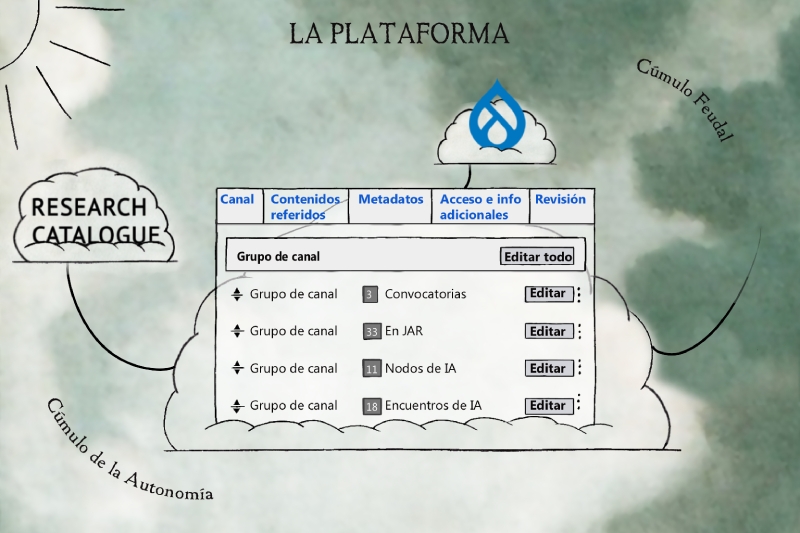
While the reflections and reviews of the JAR Network respond to traditional genres of academic writing, the Channels resemble blogs, walls or feeds that allow grouping, intertwining, and sharing 'entries', both internal and external to the journal. However, its platform, the open-access content management system Drupal, differs radically from mass networks. Designed for users with some technical knowledge, its interface can prove challenging for potential collaborators, especially when you consider the digital divide between the global South and the countries of the North. Thus, although the 'Canal en Español' seeks to question the hierarchies of the artistic-academic field, its technical infrastructure risks filtering out those who can fully participate in it. The danger is not minor: to reproduce, unintentionally, some of the asymmetries that are intended to be overcome. However, as we will see, this tension admits nuances.
Indeed, the choice of Drupal, made available to us from an 'above' that aspires to be an 'alongside', a 'beside', and a 'next to', is consistent with JAR's editorial principles. By rejecting the fluidity of 'like' and algorithmic immediacy, the Channels privilege a critical curatorial logic and a digital craftsmanship that puts reflexivity before virality. This option offers significant margins of autonomy: it allows operating in heterogeneous networks of agents, materials, and environments, implementing one of the most promising mutations in contemporary research. Strictly speaking, the digital divide, in terms of the front end of Drupal, is not insurmountable for its potential users. More worrying is that, in a context where massive networks and artificial intelligence are already taking over the production and circulation of content, spaces of greater technological autonomy are made invisible, which, like this one, can be used to consolidate extremely diverse communities, as we will see below.
The team: reticularity and heterogeneity
Due to the multinational and multilingual composition of its team, the 'Canal en Español' largely materializes JAR's reticular aspiration. In fact, it has integrated people from Argentina, Brazil, Chile, Colombia, Mexico, and the United States, with residences in their countries of origin, Europe or North America. In the JAR Network channels, committee editors propose materials and monitor progress; associate editors actively seek out and publish materials; interns support specific search and publication tasks; and coordinators also maintain communications with the panel, committee, and management (importantly, associate editors can coordinate a channel without being part of the committee). In the 'Canal en Español', in disciplinary terms, the visual arts, initially predominant, now share space with the musical arts, and there is a transversal interest in the media arts. In addition, in terms of gender, the highest female participation stands out. Currently, the Channel's team is made up of committee editors Mariela Yeregui, Yara Guasque and this writer, who were joined in the past by Manuel Ángel Macía, Jesús Fernando Monreal and intern Clare Murray.
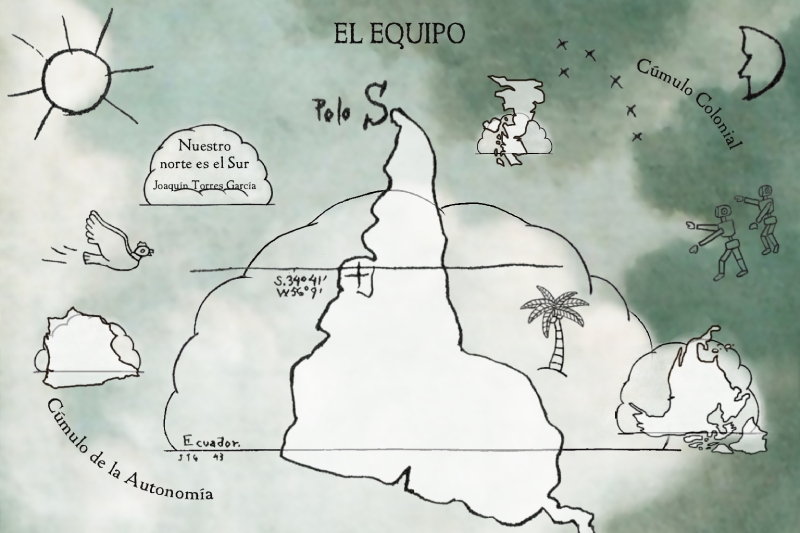
The fact that the team is mainly from the South American Cone1 deserves a mention. This continental area has the highest density of European population and the lowest density of indigenous and Afro-descendant populations, whose presence has been diluted or rendered invisible. Recalling Antonio Cornejo-Polar (1994), heterogeneity is not mere variety, since cultural and linguistic differences are stratified. Today, new migrations, media influences of the 'Latino' from Miami, and digital convergences make the scenario even more complex. In other words, idiomatic representation does not guarantee per se a representativeness of artistic research 'in Spanish'. The choice of the name 'Canal en Español' responds to a pragmatic solution: we recognize the unifying role of this colonial lingua franca, but we are aware that 'Spanish' is Castilian, the official language that hides numerous languages and linguistic hybridizations in America, Spain, and other areas. Thus, we act as bridges with Nordic artistic research from urban academic contexts, rather mestizo or Euro-descendant, middle-class and cosmopolitan that tend towards Eurocentrism. However, we are in a struggle to make visible versions that are neither Southern nor hegemonic from a decolonial eagerness reinforced by investigative practice2.

The nodal function
The channels sought to make artistic research visible around specific disciplines or topics, but which one to cover and how? We decided on the option of the 'debate' on artistic research, as Henk Borgdorff called it (2006; 2010). Starting from the questionable premise that this field was still in its infancy in Spanish-speaking countries, we sought to promote this debate through a kind of repository. Because the purpose of the channels was also to 'entangle' JAR posts with others, we heavily exploited the tool of external links. Hence, the Spanish Channel is only a 'sort' of repository: for technical reasons and intellectual property rights, the contents are not stored, but only linked. Strictly speaking, this channel functions as an activating node of connections between dispersed practices, within a vast online network that we aspire to make visible.
When Bruno Latour proposes to flatten 3D schemes to privilege 2D maps (2008), he puts a desire for horizontality before real asymmetries of power. Ideally, the 'Canal' would be a prominent point on a 2D map of knowledge about artistic research in Spanish, but this is always within limits. For example, while I was searching in Spanish for materials relating to 'investigación artística' or 'investigación-creación'– translations from English ‘artistic research’ and French ‘recherche-création’– who would have thought that there was a rich field of Mexican research around research and creation? Any language knows poetic-conceptual limits that redefine it, which requires a revision of the perception and the very name of what we understand by 'artistic research'. The challenge is reinforced by relying on algorithmic searches as the main method of accessing information, since they make invisible that which does not fit into their patterns. Thus, aspiring to horizontality, we operate with frameworks and tools that stratify knowledge. This contradiction shapes what has been a dynamic, changing and mutating approach to content and its organization; an inherent feature of a project that, in this case, is not born from systematic research, but from editorial practice and its urgencies.
The modular structure
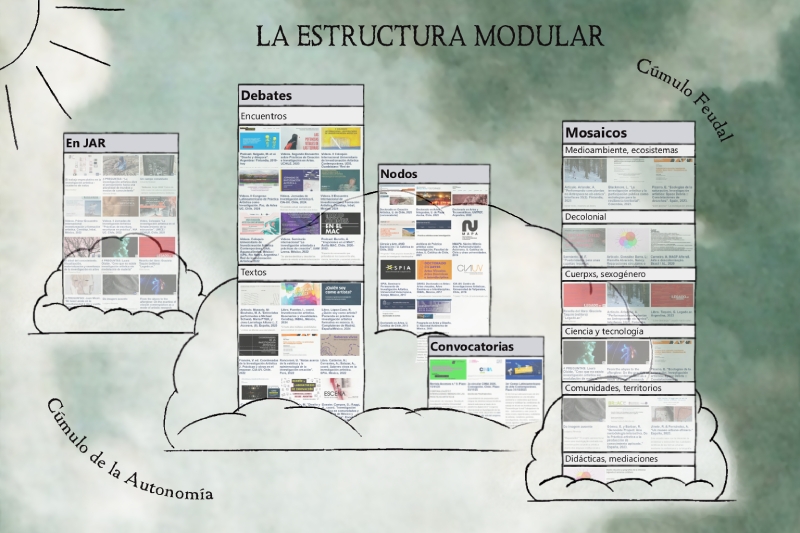
At first, registering and compiling artistic research publications in Spanish seemed simple, given the apparent scarcity of online materials. However, after four years, it is evident that the complexity lies not only in the proliferation of content driven by the creation of postgraduate courses and their validation in national knowledge systems, but also in the visibility of practices that already exist, yet were previously ignored or marginalized. This complexity led us to organize the content into three main modules (with internal sections not visible in Drupal), which have evolved over time. I present them in order of appearance, using brackets for the non-explicit modules in the interface:
- [Constellations]: space for experimental articulations, designed to bring together artistic research initiatives. Although it has not crystallized into concrete projects, it persists as an aspiration in the call for 'brief readings/looks/cross-listening' between JAR content and other materials. Today I estimate that its potential would require its own channel3.
- [Mosaics]: regroups thematic sections such as 'Environment', 'Decolonial', 'Bodies', 'Science and Technology', 'Communities', and 'Pedagogies'. These sections are not exclusive and include JAR publications. Originally second, this module was eventually displaced by the difficulty of selecting content for a growing volume of materials—a curatorial problem that, ideally, could be solved by creating new thematic channels.
- [Debates]: central module, which links external and internal materials from theoretical-epistemic-methodological approaches. It allows us to appreciate the diversity of understandings about artistic research and includes the subsections 'Encounters'4 and 'Texts'.
- In JAR: brings together contributions from the journal in Spanish (and Portuguese) (see footnote 2) and some in English from Spanish-speaking authors. It initially occupied the last place, moving to first as the volume of publications increased, but settled in second after the incorporation of 'Convocatorias' (‘Calls’). This module should also have its own channel.
- Nodes: recent module with links to centers and postgraduate programs in artistic research. Its inclusion responds to the need to map institutional actors.
- Calls: the newest module, designed to facilitate the expansion of the network in a practical way: it invites you to review the Channel and send information. It requires episodic but constant updating.
In the face of a growing production, the selection is governed by criteria of relevance, consistency, scope and access, prioritizing books, dossiers, proceedings, meetings with audiovisual recording, doctoral programs, and research centers. However, these criteria are flexible: they can be ignored in exceptional cases, such as relevant press articles or very active research centers, and free download content is always favored. While the materials are stable, that is, they stay on the platform, the modules, sections and posts are dynamic: some could migrate to new channels, adapting to the needs of the project.
Final Thoughts
The 'Canal en Español' is a dynamic assemblage where the linguistic, the cultural, the technological, and the curatorial intertwine to map – and question – the limits of Spanish-speaking artistic research. As Bruno Latour (2017) pointed out, scientific images are not mere representations, but interfaces that reveal connections while hiding others. The channels of the JAR Network operate the same way. Michael Schwab, editor-in-chief, anticipated its disruptive potential: “I believe that channels are intermediate steps towards a more radical solution. [How] would we build a space that would suspend JAR as the center, highlighting instead peripheral connections?” (internal discussion, 15/07/2020). However, this suspension is impossible without questioning the infrastructure that sustains it, especially if technological reason overwhelms even critical projects. In a ‘cloudalist’, techno-feudal context, as understood by Yanis Varoufakis (2024), public, collaborative networks based on non-(fully) algorithmic decision-making are practices of shared survival and attempts to escape. Bolstered by artistic research, the 'Canal en Español' can well be read as one such attempt.
References
Borgdorff, Henk. 2006. The Debate on Research in the Arts (Kunsthøgskolen i Bergen) <https://www.ahk.nl/fileadmin/download/ahk/Lectoraten/Borgdorff_publicaties/The_debate_on_research_in_the_arts.pdf>[accessed 28 December 2025]
Borgdorff, Henk. 2010. ‘El debate sobre la investigación en las artes’, Cairon: revista de ciencias de la danza, (13), 25-46 <https://archivoartea.uclm.es/wp-content/uploads/2018/12/cairon-13.pdf> [accessed 28 December2025]
Cornejo Polar, Antonio. 1994. ‘Introducción.’ in Escribir en el aire: Ensayo sobre la heterogeneidad socio-cultural de las literaturas andinas (Horizonte) pp.5-17
Latour, Bruno. 2008. Re-ensamblar lo social. Una introducción a la teoría del actor-red (Manantial).
Latour, Bruno. 2017. Lecciones de sociología de las ciencias (Arpa Editores)
Varoufakis, Yanis. 2023. Technofeudalism: What Killed Capitalism (Melville House)
About the images
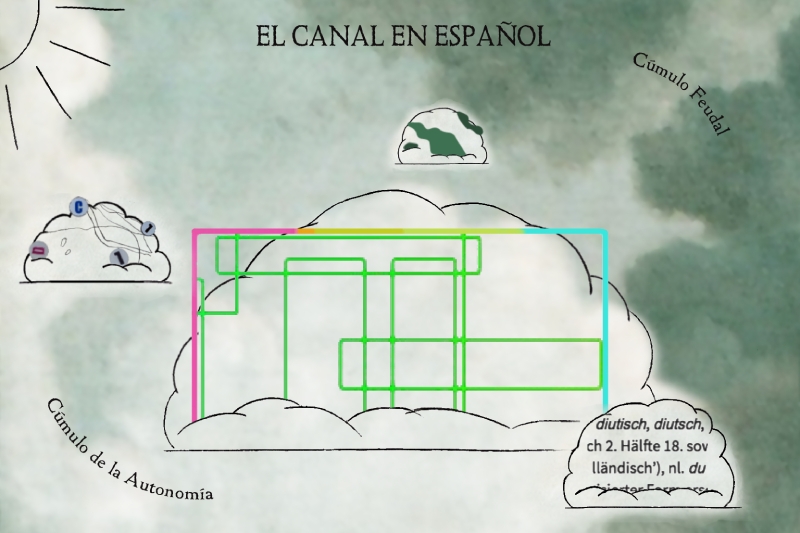
These images are based on hand-drawn sketches in an exercise book that evolved into digital collages. Additional graphic materials include: in ‘El Canal en Español’, retouched images from the JAR channels ‘Igarapés’, ‘Asia Pacific Artistic Research Network’, and ‘Diskurse im deutschsprachigen Raum’; in ‘The platform’, the logos of Drupal and Research Catalogue (this one in two lines), as well as the ‘Segoe UI’ font used by Drupal for Windows; in ‘The team’, Joaquín Torres García’s ‘América invertida’ (1943) and other retouched maps; in ‘The modular structure’, images included in the ‘Canal en Español’. In all the images, the cloudy background comes from Jacob van Ruysdael’s ‘The Windmill at Wijk bij Duurstede’ (1670), retouched, and the font used is ‘Colonial Dame’.
Biography
Carolina Benavente Morales (Chile, 1971). Experimental researcher in art, literature, and culture. She holds a PhD in American Studies with a focus on Thought and Culture from the University of Santiago de Chile and a BA in History and Political Science from the Pontifical Catholic University of Chile. Since 2021, she has been a member of the Editorial Board of the Journal for Artistic Research (JAR).
- 1In this case, Uruguay, Argentina, Chile, and southern Brazil (excluding Paraguay, which is part of it geographically).
- 2While we were interested in preserving the unity of Spanish and Portuguese proper to the Panel, we surrendered to the practical difficulty of doing so. Thus, we separated into two channels, one of them, 'Igarapés', coordinated by Yara Guasque with Elisa Noronha as associate editor, but preserving unity in terms of the publications made by JAR – and eventually some others – which are therefore 'in Spanish (and Portuguese)'.
- 3In the style of 'Igarapés', which has a more experimental character.
- 4Primarily in live-streamed videos, which experienced a significant boom during the coronavirus pandemic and have remained popular.