

The last issue for 2025 of FUKT. Magazine for Drawing, edited by Bjørn Hegardt, Max Parnell and Erika Clugston, presents a compilation of sound abstractions of different kinds: ranging from old Tibetan scores and contemporary abstract paintings inspired by sound to impressions of sound waves on glass, cable sculptures that carry sound, cartographies of warfare, graphical synthesizers, and more.
In this way, it not only showcases alluring images and the work of sound and visual artists and researchers, but it is also a compelling exploration of the possibilities of understanding sound beyond pressure waves. In this review, rather than summarizing its interviews and essays, I will approach the issue through a typology of its twenty-five contributions, including the inside cover. But first, I’d like to mention the cover, designed by Ariane Spanier, which is in itself a performance score: Small embossed regular patterns spread across the pink surface, arranged in columns, each corresponding to a sequence of three pitches (front cover) or a single pitch (back cover).
The issue includes essays by Faye Campbell, Max Parnell, and Joana P. R. Neves, alongside contributions presenting the work of numerous artists from a variety of perspectives. From the submissions, I’ve extracted four categories: instructions, archive, performance, echographies. Although imperfect, these categories are neither mutually exclusive nor sharply delimited, as is often the case with typologies. An article might fall into more than one category at the same time; two categories might share characteristics.
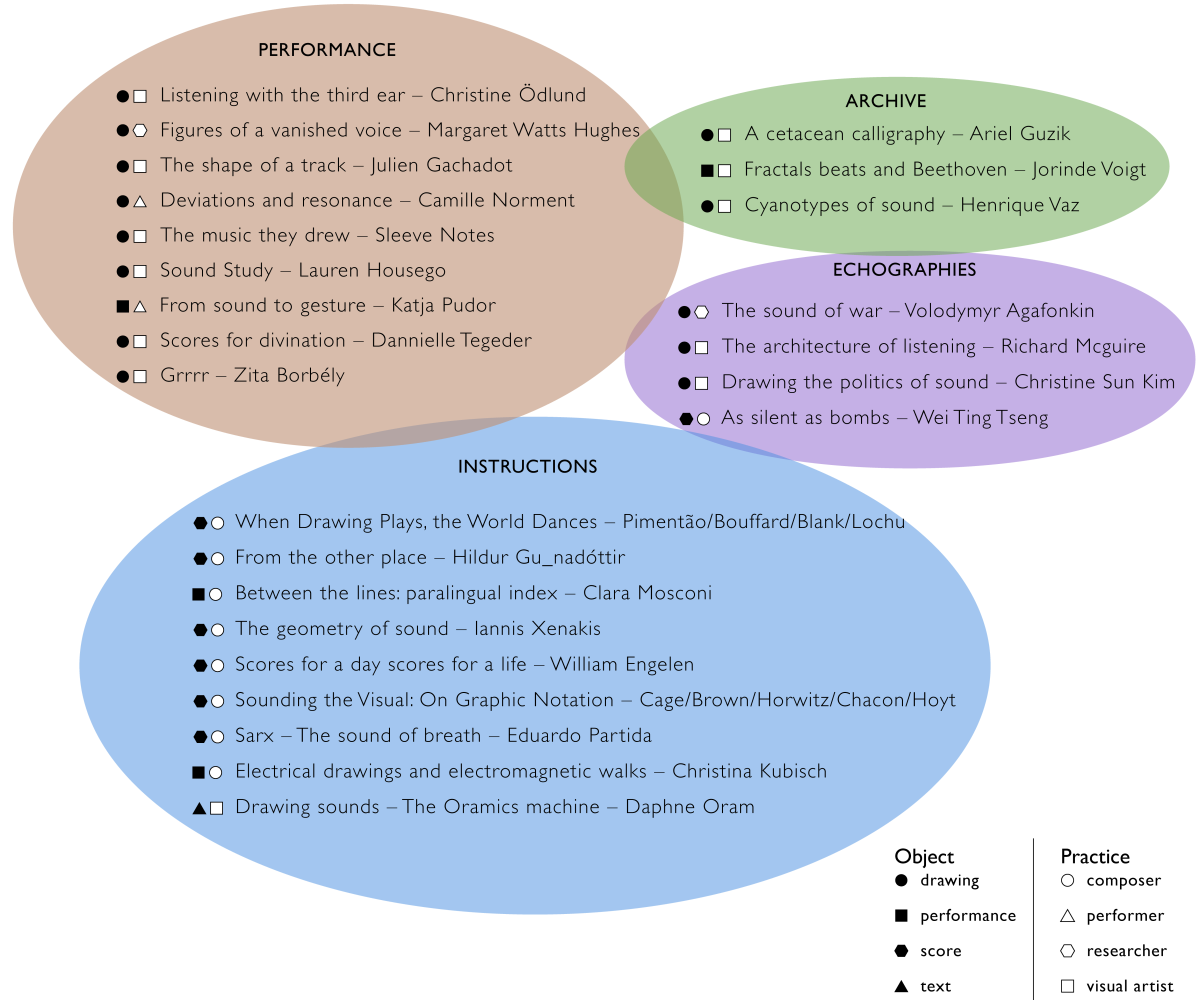
The submissions I’m here describing as “instructions” (9) are mainly that: graphical material intended and/or used as a guide to perform. “Archive” (3) refers to contributions that I see as capturing fleeting experiences, and transposing them onto paper.1 Nine contributions are best understood as performances in themselves: rather than functioning as tools for performance, the images constitute the aesthetic experience. This category also includes purely graphical performances, such as drawings.2 “Echographies” is the last of these categories. The submissions described as such (4) have an explicit relation to what we could call the “social sphere”: they are transcriptions from warfare-sounds, from social pressure and anxieties, from acoustic properties of buildings.3
Each of these categories relates to different types of information. The categories of "instructions" and "performances" offer insight into cultures of notation and performance—that is, into traditions of notated musical practice. Looking at “archive” we can get information on different subjectivities and the perception of experiences. Furthermore, “echographies” will show us something about the state of the world in a specific moment.
What all of these graphic representations share is that they operate as cross-domain mappings, transpositions of one domain—sound—onto another, image. In this sense, they are metaphors or analogies for a sound characteristic, for political and social conflicts, for something that cannot be translated into discursive language without losing something. What this issue presents is not merely the relationship between sound and graphic representation, but a remarkable document of how metaphorical knowledge is produced, of how we relate to and with the world and with each other.
- 1All performance instructions could be regarded as archive as well. As stated above, they are not mutually exclusive.
- 2In a sense, all contributions are performances, since in one way or another, they become the sound they represent.
- 3Again, all of them could fall into other categories; all the other contributions could be said to be an echography of a particular social space.