
In “The Foundation of Social Research”, Michael Crotty identifies four methodological elements of research: epistemology, theoretical perspective, methodology, and methods.
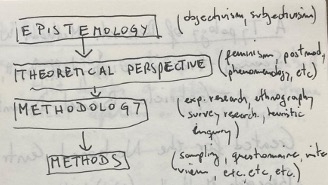
In this section, I will focus on the bottom part of the chain: Methods. The aim of this section is to work towards an overview and description of the methods of sound based artistic research, as it can be found in the different issues of the journal. This is not to be understood as a prescriptive definition, but rather, as a category that is constantly becoming. To arrive at an a priori definition of what constitutes a method would prove counterproductive; instead, I will work my way from the bottom up. Extracting explicitly (and implicitly) mentioned methods from the different sound-based publications, that is, from concrete practices, I will work my way towards a parametrization of methods in sound based artistic research. Definitions and categorizations of methods differ according to types of research studied and objective. With Rheinberger, we can think of them as operators, that is, a specific manipulation of an object, through which it is, at the same time, transformed by some factor, and conserved: “Viewed formally, an operator is a prescription for manipulating, that is, for reproducing a function such that the function itself survives the operation but at the same time is changed by some factor or factors.”1 (Rheinberger, p. 179) The change by some factor or factors is the outcome of the method, which is what will differentiate one method from another. For example, the typology of methods developed by Gabriele Beissel-Durant for the National Centre for Research Methods (UK), groups methods according to the stages of research: research design, data collection, communication & dissemination, amongst others. In his work cited before, Crotty groups and presents methods according to the hierarchy presented, that is, according to the epistemologies and theoretical perspectives under which they work. Furthermore, he defines method as “the techniques and procedures used to gather and analyse data related to some research question or hypothesis”. Looking back at Beissel-Durant’s typology, “to gather and analyse” seems to leave out important steps of research: to design the research in itself and to communicate the research process and outcomes. Furthermore, both perspectives turn a blind eye to an aspect of gathering information that is central to research practice, at least, but not only, for artistic research projects: the production of the data. For “data” is not something that just lays in the world, like wild cherries waiting to be picked by researchers, but it is something that is produced, at least in part; what constitutes valuable information and what noise is manufactured by the researcher: “The difference between information and noise derives from this decision alone, as it does from the selection of one scientific model over another. It is this selection that designates something, anything as far as information.” (Malaspina, p. 98)
From these perspectives, we arrive at methods as operations that are applied on something, be it noise or information, with a goal in mind, that preserve the departing function and at the same time returns a new one. These goals can be, for example, to find out how a specific object reacts to a specific manipulation (produce data), to store its information (gather data) and pack it in an explanation for someone (analyse and communicate), or to produce something new (create knowledge and tools).
While reviewing the first submissions for this section, I identified an array of operations being carried out by the researchers, from which I then distilled four categories of goals that overlap in part with the ones above: Experimentation, Presentation, Production, Archiving.2 These categories, however, differ from the ones derived from Crotty and Beissel-Durant in that they are not so much related to specific stages of research, but rather on how they interact with the object they are processing.
Presentation | Production | Experimentation | Archiving |
Lecture | Cocreation | Rehearsal | Recording |
Performance | Quotation | Reading aloud | Journalkeeping |
Imitation | Improvising | Notation | |
Analysis | Translation | ||
Composition | Evocation |
Turning our sight to artistic research, Henk Slager expects from it a certain critical reflection, not only aimed “outwards”, but also “inwards”, towards one’s own practice. For Slager, artistic research projects are expected to contextualize themselves, addressing two aspects: 1) What is it that conditions its material specificity, i.e., why the project is to be conducted through sound, image, language, etc., and 2) what are its tools, methods, and methodology? Through this, he says, AR-projects would create “a form of mapping”, a cartography of “our existential condition” (albeit “our” understood in a very narrow sense, as a western, privileged, academic “us”, one could say).
During the 2024 symposium “What Methods Do”, Anke Haarmann described methodology as “not a set canon” of actions and methods, instead being a something that each project needs to develop. One quality she defines, however, which seems to overlap with Slager’s expectations, is that of traceability: a hint for others who wish to follow or comprehend the researcher’s path. This speaks of a “reflexive methodology”. With this, we might characterize two types of methods to be expected in (artistic) research: on the one hand, outward oriented (spatially defined) or pro-jective (timely defined) actions, on the other inward oriented or re-jective/reflexive actions.
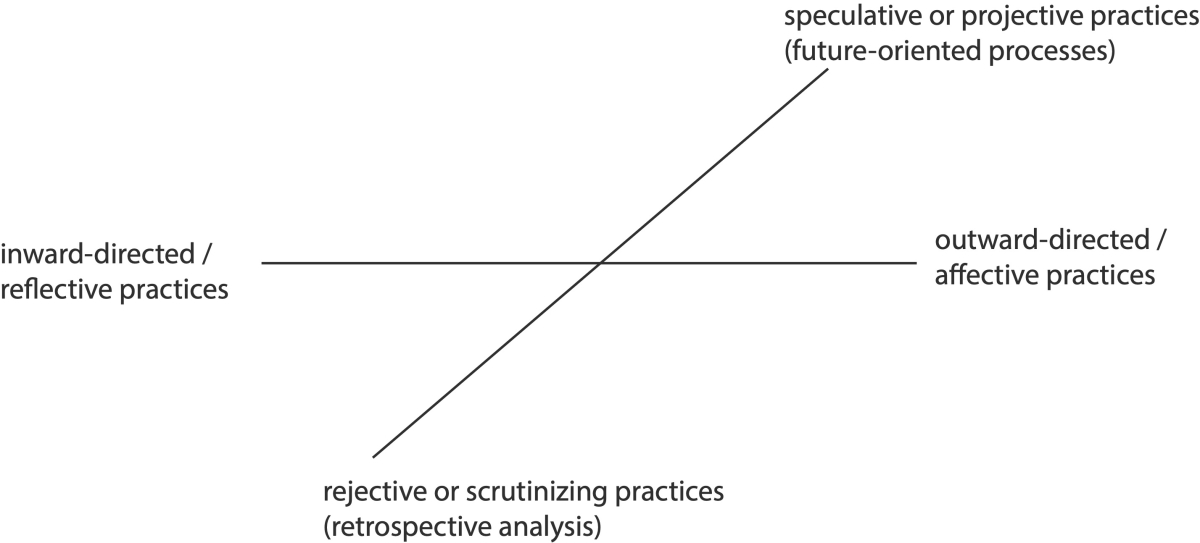
So, if we agree with them in expecting an inwards-oriented reflection, and we agree that research is outward-oriented, that is, it aims to produce something (knowledge, new materials, objects, etc.), we get a two-way oriented practice. With this, the specific goals of an operator can be reshaped as vectorial, that is, as pointing in some direction, aiming towards something. In this way, we get to a definition of a method as consisting of a pair operator-vector. The concept of vectors doesn’t end here though, but it points to spatial and temporal references. On the spatial level, practices can be
inward-oriented / reflective practices
vs.
outward-oriented / affective practices.
On the spatial dimension, they can be
speculative or projective practices
(oriented toward emergence, projection, experimentation, future-oriented processes)
vs.
rejective or scrutinizing practices
(oriented toward revision, reflection, contextualization, or retrospective analysis).
These, of course, are just the poles between practices can be located. They could be formalized into a cartesian graph, where the x-axis takes the spatial dimension, and the y-axis takes the speculative:
If we look back at the types of methods described above (Presentation, Archiving, Production, Presentation) we can find these vectorial characteristics, and order the different operations in the graph.
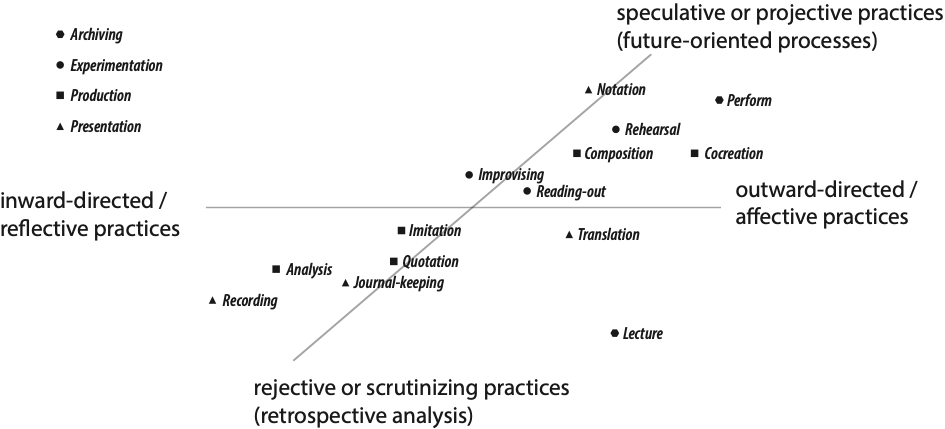
This ordering will most probably prove to be quite subjective and depending on context. As such, the graph above is only a snapshot of a moment in the research process, which, at this stage, is referred to only to two samples: 1 and 2. As such, this is at this moment not to be understood as formalized, objectively or statistically parametrized categorization, but rather a very subjective one. Future measures in this research project might involve questioning researchers, artists, and the general public on this topic. For now, this seems to be a good first stepping stone towards a methodological survey of sounding based artistic research, just a starting point, a vector to follow and eventually readjust with more data.
References
Beissel-Durrant, Gabriele. 2004. A Typology of Research Methods Within the Social Sciences. Southampton: National Centre for Research Methods.
Crotty, Michael. 1998. The Foundations of Social Research: Meaning and Perspective in the Research Process. London: Sage.
Malaspina, Cecile. 2018. An Epistemology of Noise. United Kingdom: Bloomsbury Publishing.
Rheinberger, Hans-Jörg. 1997. Toward a History of Epistemic Things: Synthesizing Proteins in the Test Tube. Stanford: Stanford University Press.
Slager, Henk. 2015. The Pleasure of Research. Berlin: Sternberg Press.
- 1This definition by Rheinberger poses a different question: if the function survives the operation, and is at the same time changed by it, does it mean that a method is reversible? If we are only given the outcome and the operation, is it possible to find out what the starting function was, and is this a requirement for something to be considered a METHOD?
- 2This, as stated in the description of the channel, is a work in progress. As such, this categorization might prove inadequate in the future, needing readjustment.